Verb Conjugations
In Japanese, verbs fall in one of two categories: Ichidan verbs and Godan verbs, also known as る and う verbs.
While beginners usually learn verbs in the form of る and う, thinking of them as Ichidan and Godan brings some advantages. Most people see the "る-verbs" as the easy ones, and "う-verbs" as the difficult ones, but once you think in the "stem-logic" - at least for me - everything falls into place.
A "stem" is a way to change the end of your verb, so that the sound ends with the sound of the stem. As a Godan example, 飲む (nomu) in the い-stem becomes 飲み (nomi). And because Hiragana doesn't have the letter "m", we shift the む to the "i" version in the "m" row: み.
For Ichidan verbs, this is even easier. In most cases, you just drop the る, and add the conjugation.
For both verb types, the う-stem is the exception, where the verb remains unchanged.
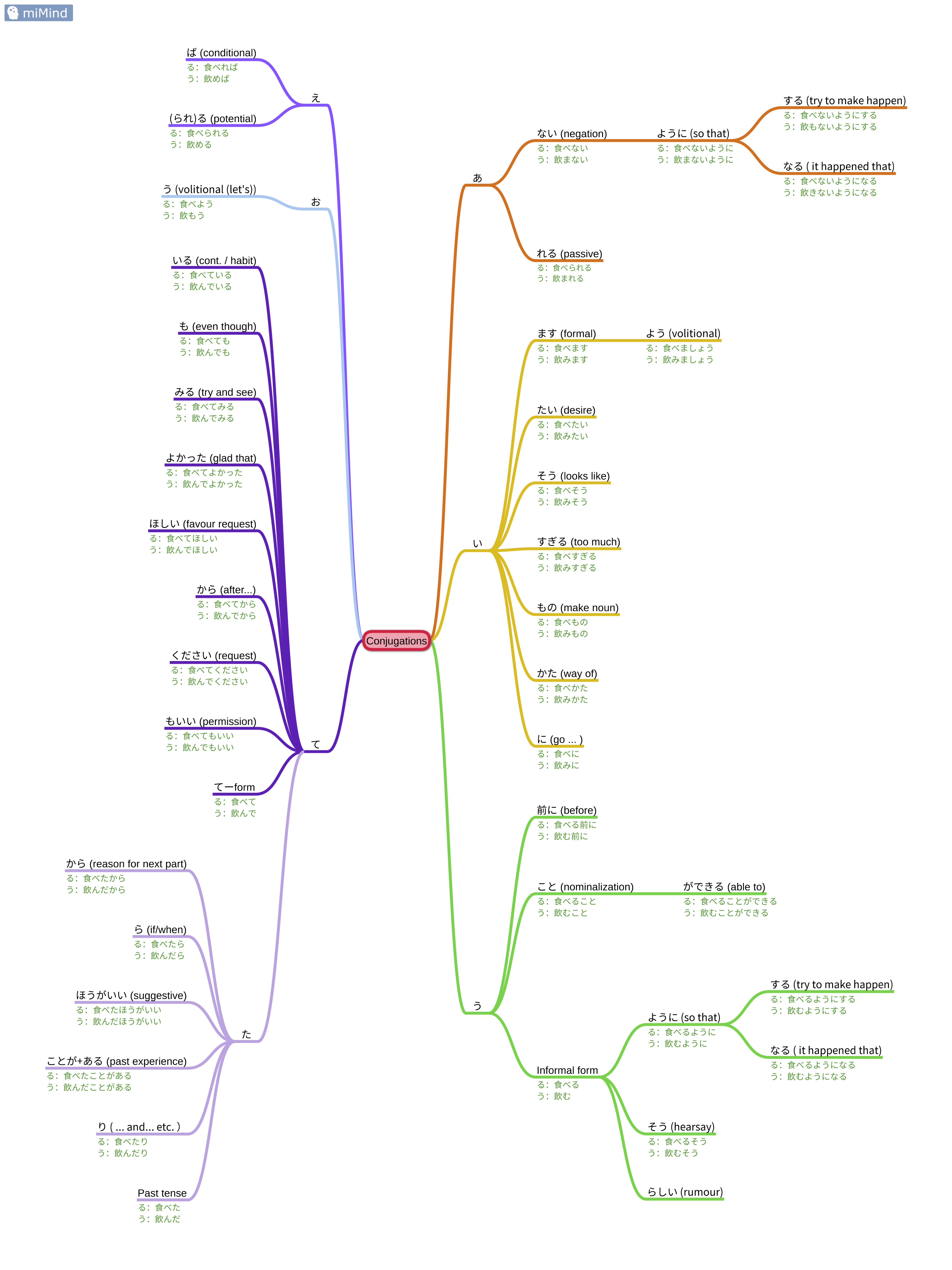
Click-able Mind-Map Tree
- あ-stem【食べ・飲ま】
- ない (negation)【食べない・飲まない】
- れる (passive) 【食べられる・飲まれる】
- い-stem【食べ・飲み】
- ます (formal) 【食べます・飲みます】
- たい (desire) 【食べたい・飲みたい】
- そう (looks) 【食べそう・飲みそう】
- すぎる (too much)【食べすぎる・飲みすぎる】
- もの (noun) 【食べもの・飲みもの】
- かた (way)【食べかた・飲みかた】
- に (purpose) 【食べに・飲みに】
- う-stem 【食べる・飲む】
- 前に (before) 【飲むまえに・食べるまえに】
- こと (thing) 【食べること・飲むこと】
- がある (have done) 【飲むことがある・食べることがある】
- ができる (can do) 【飲むことができる ・食べることができる 】
- にする (decide to do) 【飲むことにする・食べることにする】
- × (informal) 【飲む・食べる】
- よるに (so that)
- する (try to make happen)
- なる (it happened that)
- そう (hearsay)
- らしい (rumour)
- よるに (so that)
- え-stem 【食べ・飲め】
- ば (conditional) 【食べれば・飲めば】
- (られ)る (potential) 【食べられる・飲める}
- お-stem 【食べよ・飲も】
- う (volitional) 【食べよう・飲もう】
- て-stem 【食べて・飲んで】
- × (て-form) 【食べて・飲んで】
- ください (request) 【食べてください・飲んでください】
- もいい (permission) 【食べてもいい・飲んでもいい】
- も (even though) 【食べても・飲んでも】
- から (because) 【食べてから・飲んでから】
- いる (cont. / habit) 【食べている・飲んでいる】
- みる (try doing) 【食べてみる・飲んでみる】
- よかった (glad that) 【食べてよかった・飲んでよかった】
- ほしい (favour request) 【食べてほしい・飲んでほしい】
- た-stem 【食べた・飲んだ】
- × (past) 【食べた・飲んだ】
- り (enumeration) 【食べたり・飲んだり】
- ことがある (have done) 【食べたことがある・飲んだことがある】
- ほうがいい (suggestive) 【食べたほうがいい・飲んだほうがいい】
- ら (if/when) 【食べたら・飲んだら】
- から (because) 【食べたから・飲んだから】
Mindmap Image
Verbs by CEFR-J and JLPT Level
| File | JLPT | CEFR-J |
|---|---|---|
| ~ます (Polite Form) | N5 | A1.1 |
| ~ない (Negative Form) | N5 | A1.2 |
| ~もの (Nominalizer) | N5 | A1.2 |
| ~たい (Desire) | N5 | A2.1 |
| ~こと (Thing Nominalizer) | N4 | A2.2 |
| ~すぎる (Too Much) | N4 | A2.2 |
| ~そう (Looks Like) | N4 | A2.2 |
| ~たことがある (Have ever) | N4 | A2.2 |
| ~に (Purpose) | N5 | A2.2 |
| ~られる (Potential Form) | N4 | A2.2 |
| ~かた (Way of) | N4 | B1.1 |
| ~たら (Conditional Form) | N4 | B1.1 |
| ~られる (Passive Form) | N4 | B1.1 |
| ~前に (Before) | N4 | B1.1 |
| ~ば (Conditional Form) | N3 | B1.2 |